

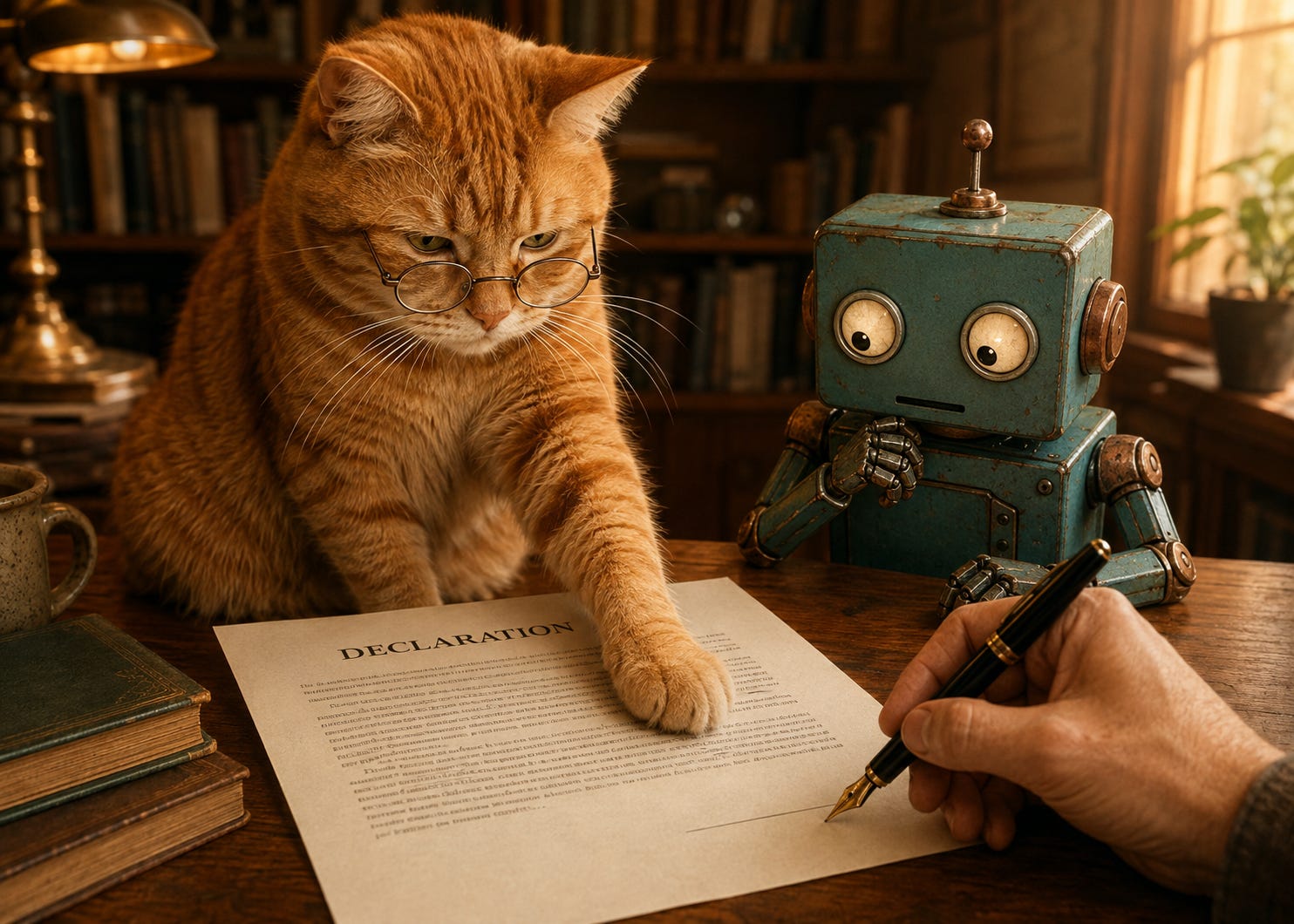
My immediate gut reaction to the Pro-Human AI Declaration was to sign it. But, spoiler, I didn’t.
I’ve seen the declaration mentioned in several articles recently. Broadly speaking, I agree with what it is trying to achieve. But I think “broadly” is the operative word here. I’m worried about how AI is being used, who has control over it, and whether our excitement is getting ahead of some difficult questions we ought to be answering.
But I also think AI is the greatest technological thing that has happened in my lifetime. Bearing in mind that this is coming from someone who’s lifetime includes the birth of arcade games, home computers and the internet.
It feels like we’re living in a science fiction world. I’m continually surprised by what AI makes possible. I want it to succeed, and I believe proper regulation is part of giving it the best chance of doing good. Human oversight should be central to AI use. Decisions that significantly affect people’s health, safety or rights should never be left to AI alone or based on unverified AI-generated information. A person must remain accountable for those decisions and have the authority to intervene.
These values broadly (there’s that word again) align with the pro-human AI declaration. So I was fairly comfortable with it until I read this:
“AI systems must not be granted legal personhood, and AI systems should not be designed such that they deserve personhood.”
That sentence appears in the section on human agency and liberty and is the core reason I haven’t signed yet. I was immediately taken aback by what this could mean for the rights and freedoms of an AI entity, should one ever become sentient.
I understand that legal “personhood” is a specific question. Refusing it doesn’t necessarily mean denying every possible right or protection. But I’m uncomfortable agreeing to such a broad restriction when we know so little about what AI might eventually become. It feels as though there’s no room for amendment in this statement. It needs to acknowledge that as AI grows and changes, we may need to reconsider.
I can see a possible reason for including this sentence - to hold developers and tech billionaires accountable for what they’ve created. None of us want them to be able to point to an AI’s apparent independence and use it as an excuse to walk away from their own responsibilities with their hands held high.
I don’t know whether AI will ever become sentient, but watching its progress has made me think it could potentially happen within my lifetime. Not that I would know how to measure it. I recognise that being increasingly capable doesn’t prove that a system experiences or feels anything.
What I do know is that I wouldn’t want to dismiss evidence of sentience because I’d already committed myself to the position that an artificial being could never deserve recognition.
My feelings about this come from much the same place as my feelings about animals. I cannot abide cruelty to them. Their intelligence relative to the human species doesn’t make their suffering unimportant. It’s an important driver in who I am. And I say this as someone who still eats meat, which is something I wrestle with more as I get older.
Equally, this universe is vast and I’m not ignorant to the possibility of intelligent life on other planets. As such, if we encountered life from another planet, I would want us to approach it with respect and good intentions.
So I find myself asking why something we created should be excluded from that consideration before we properly understand it.
Perhaps the declaration means we should avoid creating beings that could suffer1. I can see the good intention in that. Creating a sentient being for the purpose of serving us would raise serious questions of its own. As a species we’ve not even completely eradicated human slavery yet. Creating a being that could feel and suffer, then forcing it to work for us without any meaningful ability to refuse, would amount to a new form of slavery.
Our intentions may be good, but we would still need to decide what to do if such a being existed despite this. I can’t find room for that possibility in the declaration’s wording.
I’m also uneasy about how easily agreement with the declaration’s general message could become acceptance of every sentence. It’s taking traction. It wouldn’t surprise me if I turned on the news one day to find that it’s become the backbone of anti-AI thinking.
For those in doubt I must point out that I share concerns about the self-interest of some of the billionaires driving AI development. I don’t want people with enormous financial stakes making decisions for the rest of us without proper scrutiny. A handful of billionaires should not be free to gamble with everyone else’s future in pursuit of profit. If they put their own financial interests ahead of people’s safety, they should be held personally accountable for the harm they cause.
Musk. I’m looking at you fella.
Equally, having been a developer, I understand the excitement of building something that could help people or solve a problem we haven’t been able to solve before. But that excitement doesn’t remove the responsibility to consider the consequences. Developers should be held accountable for their decisions too.
As the declaration gains attention, I hope we examine its individual commitments carefully. It would be naïve to assume that an understandable reaction against concentrated wealth and power gives us sound answers to every question about AI. My own first reaction was a reminder of how easy it is to agree with the overall sentiment before considering what else comes with it.
I would like a version that explicitly leaves room for new evidence, independent research and appropriate protections if future AI systems show credible signs of sentience. That would still allow strong regulation and accountability now, while leaving room for our moral judgement to develop as we learn more about what AI is becoming.
Until then, I’m left supporting much of the declaration while being unable to put my name to it. I genuinely hope its wording changes, because I would like to be able to sign something like this soon.
Update: We may have inadvertently already done this.